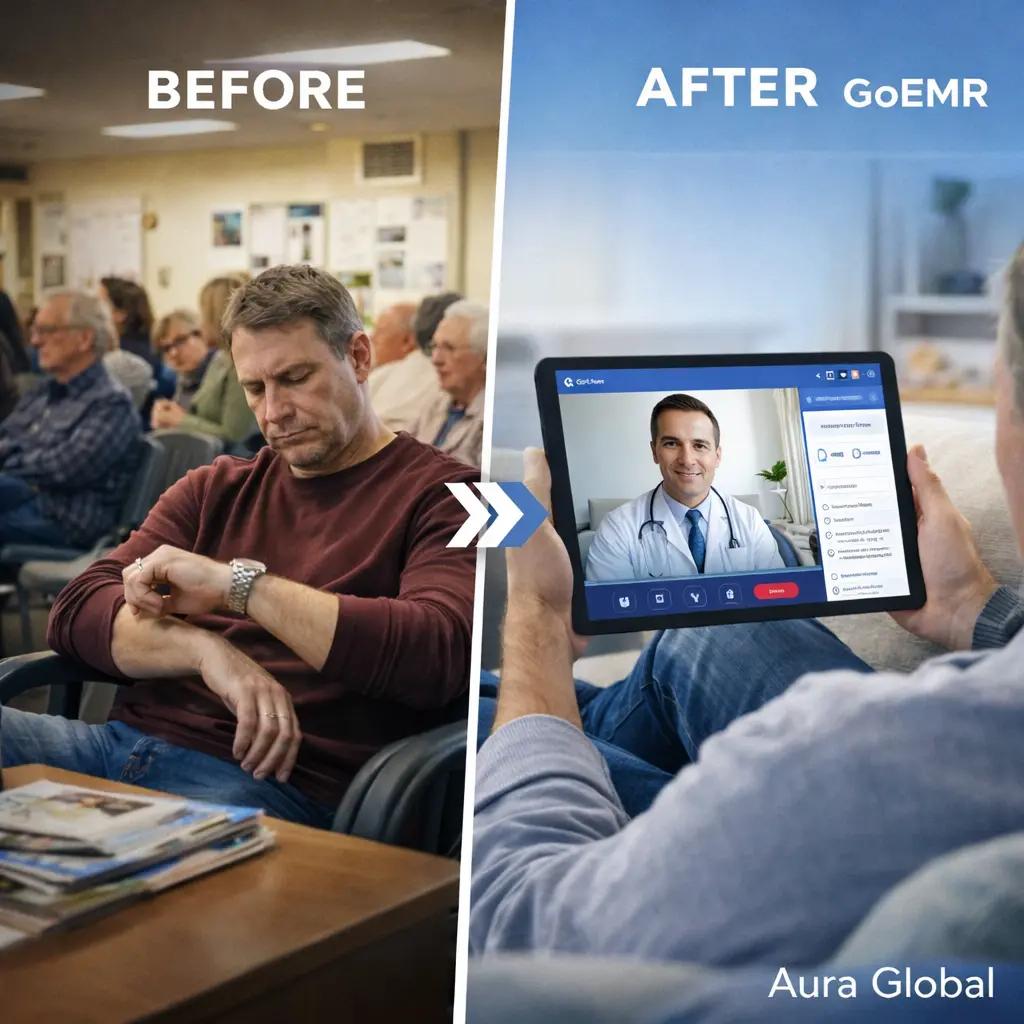
A patient drives two hours each way for a fifteen-minute follow-up. They take a half day off work. They arrange childcare. They sit in a waiting room for forty minutes past their appointment time. The provider glances at their chart, confirms the labs look fine, and says, "See you in three months."
That entire interaction could have happened on a screen — from the patient's living room, during their lunch break, or between dropping off the kids and starting dinner. The clinical value would be identical. The patient experience would be incomparably better.
AuraEMR's Telehealth module was built for exactly this: bringing the consultation room to any device, without sacrificing clinical quality, documentation, or compliance.
The Distance Problem
Geography shouldn't determine the quality of care a patient receives. But in practice, it often does. Rural patients travel hours to see specialists. Elderly patients skip follow-ups because the drive is too much. Working parents cancel appointments they can't afford to take time off for.
The numbers paint a stark picture:
- 30% of appointments in rural areas involve a round trip of over 60 miles
- Transportation barriers account for an estimated 3.6 million missed appointments annually in the U.S.
- Follow-up compliance drops significantly when patients face travel burdens — leading to worse outcomes and higher downstream costs
- Specialist access is severely limited in underserved areas, forcing patients into long waits or long drives — often both
The irony is that many of these appointments don't require a physical exam. Medication reviews, lab result discussions, mental health check-ins, post-surgical follow-ups — these are conversations. And conversations don't need a waiting room.
If a patient can describe their symptoms and a provider can see their face, hear their voice, and review their chart — that's a clinical encounter. Where it happens is secondary.
What Telehealth Actually Looks Like in 2026
The early days of telehealth were clunky. Laggy video. Dropped calls. Providers fumbling with one platform for video and another for documentation. Patients downloading apps they'd never use again. It felt like a workaround, not a workflow.
That era is over. AuraEMR's Telehealth module is built directly into the EMR — not a third-party integration, not an add-on, not a separate tab you have to switch to. It's the same system your providers already use for in-person visits, extended to virtual care.
Here's what that means in practice:
- HD video calls — Crystal-clear audio and video that doesn't degrade under normal bandwidth conditions. Providers can see skin conditions, read body language, and maintain eye contact.
- Virtual waiting room — Patients check in online and wait in a branded virtual space until the provider is ready. No more "Am I connected?" confusion.
- Screen sharing — Providers can share lab results, imaging, educational materials, or treatment plans directly on the patient's screen during the visit.
- Integrated documentation — Notes, prescriptions, and orders are captured in the same clinical record as an in-person visit. No duplicate charting. No data silos.
The result is a telehealth experience that feels native — to both the provider and the patient. It's not a separate system to learn. It's just another way to see patients.
One Link, No Downloads, No Friction
The single biggest barrier to telehealth adoption isn't technology — it's friction. Every extra step between a patient and their appointment is an opportunity for them to give up. Download this app. Create an account. Verify your email. Enter a meeting code. Allow camera access. Troubleshoot audio.
AuraEMR eliminates all of that. Here's how a telehealth visit works from the patient's perspective:
- Patient receives a link via SMS or email before their appointment
- At appointment time, they click the link
- Their browser opens directly into the virtual waiting room
- The provider admits them when ready
That's it. No app to download. No account to create. No software to install. The visit runs entirely in the browser — on a phone, tablet, laptop, or desktop. It works on iOS, Android, Windows, Mac, and ChromeOS.
This matters enormously for older patients, less tech-savvy patients, and anyone who's already frustrated with the healthcare system's complexity. The fewer barriers you put in front of them, the more likely they are to show up.
The best telehealth platform is the one your patients actually use. That means zero friction — not low friction.
More Than Just a Video Call
A video call alone isn't telehealth — it's FaceTime with a medical degree. Real telehealth requires clinical infrastructure around the conversation. AuraEMR provides that infrastructure.
During a AuraEMR telehealth visit, providers have access to:
- Full patient chart — Demographics, medical history, medications, allergies, and recent visits are displayed alongside the video feed. No toggling between windows.
- Real-time vitals sidebar — For patients using connected devices (blood pressure cuffs, pulse oximeters, glucometers), readings stream directly into the visit.
- In-visit prescribing — Providers can write and send prescriptions during the visit, just as they would in person. The prescription hits the pharmacy before the patient closes their browser.
- Chat panel — A text chat alongside the video for sharing links, spelling out medication names, or communicating when audio quality dips.
- Visit summary generation — After the visit, patients receive an automated summary with instructions, prescriptions, and follow-up details — no manual after-visit paperwork.
This is what separates a telehealth module from a telehealth hack. When the video, the chart, the documentation, and the prescribing all live in one system, virtual visits become just as clinically robust as in-person ones.
HIPAA Compliance Built In, Not Bolted On
During the pandemic, regulatory bodies temporarily relaxed telehealth requirements — allowing providers to use consumer platforms like Zoom, FaceTime, and Google Meet. That flexibility was necessary in a crisis. But it was never meant to be permanent.
Those waivers are gone. HIPAA enforcement is back in full force, and using a non-compliant platform for telehealth is a liability waiting to happen. The penalties aren't theoretical:
- Fines up to $50,000 per violation for willful neglect, with annual maximums of $1.5 million per violation category
- Breach notification requirements that can damage patient trust and practice reputation
- State-level penalties that stack on top of federal ones in many jurisdictions
AuraEMR's telehealth is HIPAA-compliant by design. Every video session is encrypted end-to-end. Recordings (when enabled) are stored in encrypted, access-controlled environments. Audit logs track who accessed what, when, and from where. Business Associate Agreements are built into the platform — not a separate PDF you have to chase down.
Compliance isn't a feature you toggle on. It's the foundation everything else is built on.
Who Benefits Most
Telehealth isn't a replacement for all in-person care. It's a complement — and for certain use cases, it's dramatically better than the alternative.
The practices and scenarios where AuraEMR Telehealth delivers the most impact:
- Rural clinics — Patients in underserved areas gain access to specialists without the burden of long-distance travel. A dermatologist in the city can evaluate a rash for a patient three counties away.
- Post-operative follow-ups — Most post-op checks are visual assessments and Q&A. Patients recovering from surgery shouldn't have to endure a car ride to confirm they're healing on schedule.
- Chronic disease management — Diabetes, hypertension, COPD — conditions that require frequent check-ins but rarely require hands-on examination. Regular virtual visits improve adherence and catch problems earlier.
- Mental and behavioral health — Therapy and psychiatric consultations are inherently conversational. Many patients actually prefer the comfort and privacy of their own space.
- Specialist referrals — Instead of waiting weeks for an in-person specialist appointment, a PCP can arrange a virtual consult within days. Faster diagnosis. Faster treatment. Better outcomes.
- Pediatric sick visits — A parent with a feverish toddler at 7 PM doesn't want to drive to urgent care. A quick telehealth visit can determine if it's something that needs immediate attention or can wait until morning.
Telehealth isn't the future anymore — it's the standard. The practices that recognized this early are already seeing higher patient satisfaction, fewer no-shows, and better clinical outcomes. The rest are still asking patients to drive two hours for a fifteen-minute conversation.
Bring the consultation room to any device
AuraEMR Telehealth delivers HD video visits, virtual waiting rooms, screen sharing, and integrated documentation — all HIPAA-compliant, all in one system. No app downloads. No friction. Just better care, from anywhere.