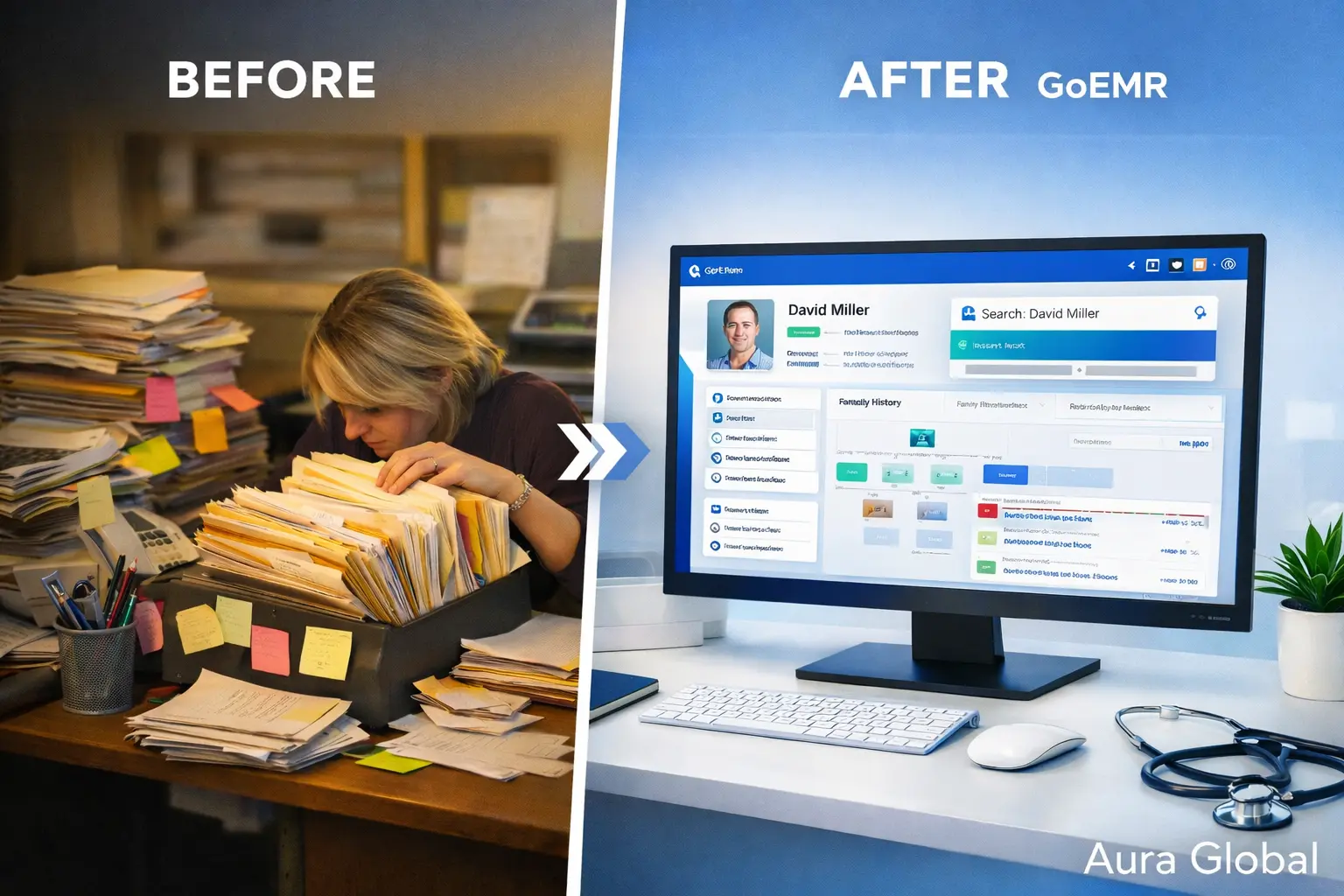
There's a scene that plays out in clinics every single day: a patient walks in, the front desk scrambles to locate their chart, and five minutes of flipping through a filing cabinet later, someone realizes the chart is still on a provider's desk from yesterday. Meanwhile, the patient waits. The line grows. And the day falls behind before it's even started.
This isn't a minor inconvenience. It's a systemic problem that drains time, introduces errors, and frustrates everyone involved — staff and patients alike. AuraEMR's Patient Management module was built to eliminate this friction entirely.
The Paper Chart Problem
Paper-based patient management might have worked when a practice had fifty patients and one physician. But clinics grow. Patient panels expand. Staff turns over. And suddenly the filing system that "worked fine" becomes a daily obstacle course.
The problems with paper charts aren't subtle — they're structural:
- Charts go missing — They get misfiled, left on desks, or accidentally taken home. A missing chart can delay an entire appointment.
- Information is scattered — Demographics in one folder, lab results in another, referral letters stuffed in a third. Assembling the full picture takes time you don't have.
- Handwriting is unreliable — Illegible notes cause errors in medication, dosage, and diagnosis. This isn't an annoyance — it's a patient safety risk.
- Nothing is searchable — Need to find every patient on a specific medication for a recall? With paper charts, that means manually reviewing every single file.
A chart sitting in a filing cabinet is just paper. A chart in a digital system is actionable clinical data.
What Gets Lost in the Shuffle
The real cost of disorganized patient management isn't just wasted time — it's lost clinical context. When patient information is fragmented across paper files, fax machines, and sticky notes, providers are making decisions with incomplete data.
Consider what a provider needs during a typical patient encounter:
- Current medications and dosages
- Allergies and adverse reactions
- Family medical history
- Recent lab results and imaging
- Referral history and specialist notes
- Insurance and contact information
In a paper-based system, gathering all of this can take several minutes per patient — if it's all even available. Multiply that by 20 to 30 patients a day, and you're looking at hours of lost clinical time spent just assembling information that should be at your fingertips.
Worse, when something is missing, providers either proceed without it (risky) or delay the encounter to track it down (costly). Neither outcome is acceptable.
One Patient, One Unified View
AuraEMR's Patient Management module takes a fundamentally different approach: every piece of patient information lives in one place, accessible in one click.
When you pull up a patient in AuraEMR, you see everything — demographics, family history, medical records, medications, allergies, insurance details, and contact information — all in a single, clean interface. No hunting. No cross-referencing. No "let me check the other folder."
Here's what that looks like in practice:
- Demographics at a glance — Name, date of birth, gender, address, emergency contacts, and preferred language. Updated once, available everywhere.
- Complete medical history — Past diagnoses, surgeries, hospitalizations, and chronic conditions in a structured, chronological view.
- Family history mapping — Hereditary risk factors documented and flagged so providers can make informed screening decisions.
- Active medication list — Current prescriptions, dosages, prescribing provider, and refill status — with automatic drug interaction alerts.
- Insurance and billing info — Primary and secondary coverage, policy numbers, and authorization status without switching to a separate billing module.
The result is that providers walk into every encounter with the full clinical picture already assembled. No prep time. No surprises. Just better care.
Search That Actually Works
One of the most underrated features of a good patient management system is search. Not the kind where you type a name and hope for the best — real, flexible, multi-parameter search that finds the right patient instantly.
AuraEMR lets you search by:
- Name — Full name, partial name, or phonetic match for misspellings
- Patient ID — Direct lookup by unique identifier
- Phone number — Find a patient from a missed call or incoming message
- Date of birth — Disambiguate common names instantly
- Biometric match — For clinics using fingerprint or facial recognition check-in
This matters more than most people realize. In a busy clinic, the front desk might receive a call from a patient who only gives their first name and date of birth. Or a specialist might need to pull up a referred patient using just a phone number from a fax cover sheet. Rigid, name-only search fails in these scenarios. AuraEMR's search doesn't.
If your staff can't find a patient record in under five seconds, your system is the bottleneck — not your staff.
No More Duplicate Records
Duplicate patient records are one of healthcare's most persistent data quality problems. They happen when a patient is registered twice — maybe with a slight name variation, a different phone number, or a typo in their date of birth. The consequences are serious:
- Split medical history — Half the patient's data is in one record, half in another. Providers see an incomplete picture.
- Medication errors — A duplicate record might not show a current prescription, leading to dangerous drug interactions.
- Billing discrepancies — Claims submitted under the wrong record cause denials and delays.
- Inflated patient counts — Practice analytics become unreliable when one patient appears as two.
AuraEMR addresses this with intelligent duplicate detection built directly into the registration workflow. When a new patient is being entered, the system automatically checks for existing matches based on name, date of birth, phone number, and other identifiers. If a potential duplicate is found, staff are alerted before a new record is created.
For existing duplicates, AuraEMR provides merge tools that let administrators consolidate records without losing any clinical data. The result is a clean, reliable patient database that providers can trust.
Built for Real Clinics
AuraEMR's Patient Management module wasn't designed in a vacuum. It was built by Aura Global for the clinics and hospitals that refuse to stay stuck in the past — practices that need their technology to keep up with the pace of real patient care.
That means:
- Fast performance — Patient records load in under a second, even in databases with hundreds of thousands of records.
- Role-based access — Front desk sees scheduling and demographics. Providers see clinical data. Billing sees financial information. Everyone sees only what they need.
- Audit trail — Every access, edit, and view is logged. HIPAA compliance isn't an add-on — it's built into the foundation.
- Multi-location support — For practices with multiple clinics, patient records follow the patient, not the location.
The goal is simple: when a patient walks through your door, their complete history should be ready before they sit down. No paper. No delays. No excuses.
Patient management that keeps up with your practice
AuraEMR's Patient Management module gives you instant access to demographics, medical history, medications, and more — all in one unified view. Built for clinics that are done with paper charts and lost files.