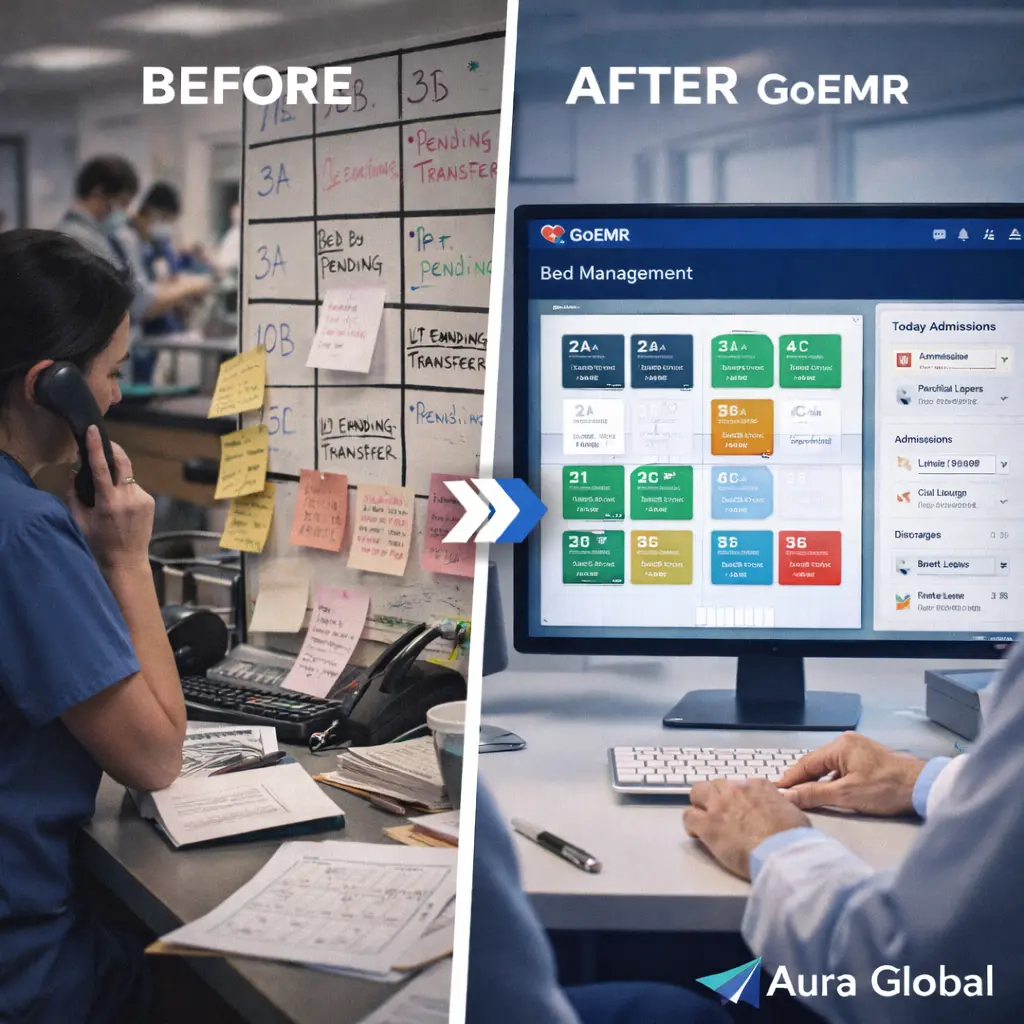
"Is bed 4B clean? Where's the transfer patient going? Who's being discharged today?" If these questions are being answered by shouting down the hallway, walking to the whiteboard, or paging the charge nurse for the fifth time this hour — your hospital has a bed management problem. And it's not a minor one.
Inpatient bed management is the circulatory system of a hospital. When it works, patients flow smoothly from the emergency department to the ward, from the ward to the step-down unit, from the step-down unit to discharge. When it doesn't, everything backs up. ED patients board for hours waiting for an inpatient bed. Surgical cases get delayed because post-op beds aren't available. Discharge-ready patients sit in beds that someone else needs because the paperwork hasn't been processed. Housekeeping cleans the wrong room. Transport shows up at the wrong floor. And somewhere in the middle of it all, a charge nurse is trying to coordinate the chaos with a whiteboard, a phone, and a prayer.
AuraEMR's Inpatient ADT module replaces the whiteboard with a real-time digital bed map. Color-coded occupancy. Automated Admit-Discharge-Transfer workflows with instant notifications. Housekeeping integration that tracks room turnaround to the minute. Average discharge time tracking that turns gut feelings into data. Every bed. Every patient. Every status. One screen.
The Bed Management Chaos
Hospital bed management is one of those operational problems that seems simple until you try to solve it at scale. A 200-bed hospital with an average length of stay of 4 days processes roughly 50 admissions, 50 discharges, and 20 internal transfers every single day. That's 120 bed status changes in 24 hours. Each one involves coordination between admitting, nursing, housekeeping, transport, case management, and sometimes dietary and pharmacy. One missed handoff creates a cascade of delays.
Here's what bed management looks like without a real-time system:
- The whiteboard problem — Most nursing stations still use a physical whiteboard to track bed status. A nurse writes "D/C" next to a patient name when the discharge order is signed. Another nurse erases it when the patient leaves. Someone writes "dirty" when housekeeping is called. Someone else writes "clean" when housekeeping finishes. The whiteboard is always slightly out of date because updating it requires someone to physically walk to the board and write on it. During a busy shift, the board might be 30 minutes behind reality — which is an eternity when the ED has six patients waiting for beds.
- The phone tag problem — Without a digital system, bed status updates travel by phone. The floor nurse calls the charge nurse. The charge nurse calls bed control. Bed control calls the ED. The ED calls transport. Transport calls back to confirm. Each call takes 2-3 minutes. Multiply that by 120 daily bed transitions, and the hospital is burning 4-6 hours of nursing time per day on phone calls about beds. That's a full FTE dedicated to nothing but asking "is this bed ready yet?"
- The invisible discharge problem — A physician writes a discharge order at 10:00 AM. The patient isn't actually out of the bed until 2:00 PM. Four hours. In those four hours, the bed appears "occupied" in every system, even though the patient is medically cleared and waiting for a ride, a prescription, or final paperwork. Meanwhile, an ED patient who needs that bed continues to board. The discharge process has a dozen steps — medication reconciliation, discharge instructions, follow-up scheduling, transport coordination — and without a system that tracks each step, nobody knows where the bottleneck is.
- The misallocation problem — Not all beds are interchangeable. A telemetry bed can't be assigned to a patient who needs ICU monitoring. A negative-pressure isolation room shouldn't be used for a routine admission when a flu patient needs it. A bariatric bed can't be swapped for a standard bed. Without a system that tracks bed attributes and matches them to patient requirements, the wrong patient ends up in the wrong bed — requiring a transfer that starts the whole process over again.
- The surge problem — On a normal day, the chaos is manageable. During a surge — flu season, a mass casualty event, a community health crisis — the whiteboard collapses entirely. The hospital needs to know, in real time, exactly how many beds are available, where they are, what type they are, and how soon occupied beds will turn over. A whiteboard can't answer those questions. A phone tree can't answer them fast enough. The hospital flies blind during the moments when visibility matters most.
A hospital bed isn't just a piece of furniture. It's a resource that costs thousands of dollars per day. Managing it with a whiteboard and a phone is like running an airline without a reservation system.
Real-Time Bed Map
The bed map is the centerpiece of AuraEMR's Inpatient ADT module. It's a visual, real-time representation of every bed in the hospital — organized by unit, floor, and wing — that updates the instant a status changes. No whiteboard. No phone calls. No guessing.
AuraEMR's bed map gives every stakeholder the same picture at the same time:
- Color-coded occupancy — Each bed on the map is color-coded by status: occupied (blue), vacant-clean (green), vacant-dirty (yellow), pending discharge (orange), blocked/maintenance (red), and reserved (purple). The color scheme is visible from across the room on a wall-mounted display or instantly readable on a tablet at the nursing station. A single glance tells the charge nurse exactly how many beds are available and where they are.
- Patient-level detail on hover — Click or tap any occupied bed and AuraEMR displays the patient's name, MRN, admitting diagnosis, attending physician, admission date, expected length of stay, and current care status. The charge nurse doesn't need to open a separate chart or call the floor. The information is right there on the map.
- Bed attribute filtering — Not all beds are equal, and the bed map lets you filter by attributes. Show only telemetry beds. Show only isolation rooms. Show only ICU beds. Show only beds near a nursing station. When bed control needs to find a specific type of bed for an incoming admission, the filter reduces a 200-bed hospital to the 8 beds that actually match the patient's requirements.
- Unit-level and hospital-level views — The bed map supports multiple zoom levels. A charge nurse on the medical-surgical floor sees their unit in detail. A bed control coordinator sees the entire hospital at once. An administrator sees occupancy percentages by unit with drill-down capability. Each role gets the view that matches their decision-making scope.
- Real-time update architecture — AuraEMR's bed map uses a real-time event system. When a nurse marks a bed as vacant, the change appears on every connected screen within seconds. When housekeeping marks a room as clean, the bed map updates instantly. There's no refresh button. There's no sync delay. The map reflects reality because it's connected directly to the workflows that change reality.
The bed map doesn't just show you where patients are. It shows you where the capacity is, where the bottlenecks are forming, and where the next admission should go — before the phone rings.
ADT Workflow Engine
Admit-Discharge-Transfer. Three words that describe the three most important patient flow events in a hospital. Every admission fills a bed. Every discharge frees one. Every transfer moves a patient from one level of care to another. In a well-run hospital, these events are coordinated, timely, and documented. In most hospitals, they're fragmented across multiple systems, multiple departments, and multiple phone calls.
AuraEMR's ADT workflow engine unifies these events into a single, automated pipeline:
- Admission workflow — When an admission order is placed — whether from the ED, a direct admit from a physician's office, or a scheduled surgical admission — AuraEMR initiates the admission workflow automatically. The system checks bed availability based on the patient's requirements (level of care, isolation needs, proximity preferences), suggests the optimal bed assignment, and notifies the receiving unit. The admitting nurse receives an alert with the patient's name, diagnosis, and estimated arrival time. The bed map updates from "vacant-clean" to "reserved" to "occupied" as each step completes.
- Discharge workflow — Discharge is where most hospitals lose time, and AuraEMR tracks every step. When a discharge order is signed, the system triggers a structured workflow: medication reconciliation, discharge instructions generated, follow-up appointments scheduled, prescriptions sent to pharmacy, transport requested, and patient education materials prepared. Each step has an assigned owner and a timestamp. The charge nurse can see at a glance which discharge steps are complete and which are blocking the patient's departure. No more calling five departments to find out why a discharge-ready patient is still in bed.
- Transfer workflow — Internal transfers — from ICU to step-down, from step-down to medical-surgical, from medical-surgical to rehabilitation — are managed with the same rigor as admissions. The transferring unit initiates the request. AuraEMR verifies bed availability at the receiving unit. The receiving nurse is notified with clinical handoff information. Transport is dispatched. Both beds update on the bed map simultaneously — one from occupied to vacant-dirty, the other from reserved to occupied. The handoff happens cleanly because the system coordinates it, not a series of phone calls.
- Automatic notifications — Every ADT event triggers notifications to the relevant stakeholders. Admissions notify the floor nurse, the attending physician, dietary, and pharmacy. Discharges notify housekeeping, bed control, and the billing department. Transfers notify both the sending and receiving units, transport, and the attending physician. Notifications are role-based and configurable — the charge nurse sees everything; the dietary department only sees admissions and diet orders. Nobody is out of the loop, and nobody is drowning in irrelevant alerts.
- Order set integration — ADT events are linked to clinical order sets. An admission to the cardiac unit automatically loads the cardiac admission order set. A transfer to the ICU triggers ICU standing orders. A discharge generates the appropriate take-home medication list and follow-up orders. The ADT workflow doesn't just move the patient — it ensures the clinical orders move with them.
A patient who waits 4 hours for a bed that's been empty for 2 hours isn't experiencing a capacity problem. They're experiencing a coordination problem. ADT automation solves coordination.
Housekeeping Integration
The fastest discharge in the world means nothing if the bed sits dirty for 90 minutes afterward. Room turnaround — the time from patient departure to the bed being ready for the next patient — is one of the most critical metrics in hospital operations, and it's almost entirely dependent on housekeeping response time. In most hospitals, housekeeping finds out about a vacant bed through a phone call, a text message, or sometimes just by walking the halls and checking. This is where AuraEMR changes the game.
AuraEMR integrates housekeeping directly into the ADT workflow:
- Automatic dispatch — The moment a patient leaves a bed, AuraEMR changes the bed status to "vacant-dirty" and dispatches a cleaning request to the housekeeping team. The request includes the room number, the unit, the type of cleaning required (standard turnover, terminal clean for isolation patients, or deep clean), and the priority level. High-priority rooms — those with patients waiting in the ED or in pre-op — are flagged for immediate attention. No phone call. No delay. The request is dispatched before the elevator doors close behind the departing patient.
- Mobile housekeeping app — Housekeeping staff receive cleaning requests on a mobile device. They can see their queue of pending rooms sorted by priority, accept an assignment, mark a room as "cleaning in progress," and mark it as "clean" when finished. Each status change updates the bed map in real time. The charge nurse watching the bed map sees the bed go from yellow (dirty) to a pulsing yellow (cleaning in progress) to green (clean and ready). No phone call to check. No walking to the room to verify. The system shows the truth.
- Turnaround time tracking — AuraEMR timestamps every step of the room turnaround: patient departure, housekeeping notification, housekeeping arrival, cleaning start, cleaning complete, bed available. This produces granular turnaround metrics by room, by unit, by shift, and by housekeeper. A hospital that discovers its average turnaround is 75 minutes can drill down to find that the bottleneck is a 40-minute gap between notification and arrival during the evening shift — and fix it with targeted staffing.
- Escalation rules — If a dirty bed isn't claimed by housekeeping within a configurable time window (default: 15 minutes), AuraEMR escalates the request to the housekeeping supervisor. If it's not claimed within 30 minutes, it escalates to the nursing supervisor. Beds with patients waiting in the ED are escalated more aggressively. The system ensures that no bed sits dirty because a request fell through the cracks.
- Infection control protocols — Rooms that housed patients with infectious conditions are automatically flagged for terminal cleaning. AuraEMR tracks which cleaning protocol was used, which disinfectants were applied, and whether the required contact time was met. The bed doesn't change to "clean" until the full protocol is documented. This protects the next patient and creates an auditable infection control record.
Room turnaround is where operational efficiency meets patient safety. A clean bed that's ready 30 minutes faster means 30 fewer minutes of ED boarding, 30 fewer minutes of surgical delay, and 30 fewer minutes of a patient sitting in a hallway on a gurney. AuraEMR makes every minute of turnaround visible, measurable, and improvable.
Discharge Time Tracking
Ask any hospital administrator what their average discharge time is, and most will give you a number that's either a guess or a billing system average that doesn't reflect reality. The billing system knows when the discharge order was signed and when the account was closed. It doesn't know the 47 things that happened in between. AuraEMR does.
AuraEMR tracks discharge as a multi-step process, not a single event:
- Milestone timestamps — AuraEMR captures the time of every discharge milestone: discharge order signed, medication reconciliation completed, discharge instructions reviewed with patient, prescriptions sent to pharmacy, follow-up appointments confirmed, patient education delivered, transport requested, transport arrived, patient departed room, room marked vacant. Each milestone creates a data point. Connected, they create a complete picture of how long discharge actually takes and where the time goes.
- Bottleneck identification — When average discharge time is 4 hours, the question isn't "why is it 4 hours?" The question is "which step is taking the longest?" AuraEMR's analytics break down discharge time by milestone. If medication reconciliation averages 15 minutes but waiting for pharmacy to process the take-home medications averages 90 minutes, the bottleneck is pharmacy processing, not the clinical team. The data points to the fix.
- Discharge prediction — Based on historical patterns and current milestone progress, AuraEMR predicts when a patient will actually leave the bed. A patient whose discharge order was signed at 9:00 AM and whose medication reconciliation was completed at 9:30 AM is predicted to depart by 12:30 PM based on the average time for the remaining steps. Bed control can use this prediction to plan incoming admissions — reserving the bed before it's physically vacant because the system knows when it will be.
- Before-noon discharge tracking — Industry best practice targets discharging patients before noon to free beds for afternoon admissions. AuraEMR tracks the percentage of patients discharged before noon, broken down by unit, by physician, and by day of week. A unit that consistently discharges late can see why: late rounding times, slow lab turnaround for morning draws, or delayed pharmacy processing. The metric becomes actionable because the data is granular.
- Length of stay monitoring — AuraEMR tracks actual length of stay against expected length of stay for each DRG. Patients who exceed their expected LOS trigger alerts to case management, prompting a review of whether continued inpatient care is medically necessary or whether barriers to discharge can be addressed. This isn't about rushing patients out — it's about ensuring that patients who are ready to go aren't staying longer than they need to because of process failures.
You can't improve what you can't measure. If "discharge" is a single timestamp in your system, you're measuring the wrong thing. Discharge is a process — and every step in that process is an opportunity to save time.
Census and Capacity Reporting
A hospital's census — the number of patients occupying beds at any given time — is the single most important operational number in the building. It drives staffing decisions, supply chain orders, dietary planning, pharmacy workload, and revenue projections. When the census is wrong, everything downstream is wrong. And in hospitals that track census manually or update it once a day, the census is always wrong.
AuraEMR provides real-time census and capacity reporting that's always current:
- Live census dashboard — AuraEMR's census dashboard shows current occupancy for every unit, every floor, and the hospital as a whole. The numbers update in real time as admissions, discharges, and transfers occur. At 2:00 PM, the census reflects every ADT event that happened up to 2:00 PM — not last night's midnight count. Administrators, charge nurses, and bed control coordinators all see the same number at the same time.
- Capacity forecasting — AuraEMR uses historical admission patterns, scheduled surgical cases, predicted discharges, and current ED volume to forecast capacity 12, 24, and 48 hours ahead. If the system predicts that tomorrow's admissions will exceed available beds, the alert goes out today — giving administrators time to expedite discharges, open overflow beds, or divert ambulances before the crisis hits. Proactive capacity management replaces reactive scrambling.
- Unit-level staffing metrics — Census data feeds directly into staffing calculations. AuraEMR tracks the nurse-to-patient ratio by unit in real time. When an admission pushes a unit past its target ratio, the system alerts the charge nurse and the staffing office. When a discharge brings the ratio below threshold, float pool resources can be reassigned. Staffing decisions are driven by current data, not the schedule that was made three days ago.
- Surge and diversion management — During high-census events, AuraEMR provides a surge management view that highlights available capacity by acuity level, tracks ED boarding times, and monitors diversion status. Administrators can see at a glance whether the hospital can accept incoming patients or needs to activate surge protocols. The data supports the decision in real time, rather than relying on gut feel during a crisis.
- Regulatory and compliance reporting — AuraEMR generates the census and capacity reports required by state health departments, CMS, and accrediting bodies. Daily midnight census, average daily census, bed utilization rates, average length of stay, and occupancy percentages are calculated automatically and available for export. Reports that used to require a data analyst and a spreadsheet are generated with a single click.
Every bed in a hospital is a revenue-generating asset, a clinical resource, and a patient safety factor. Managing those beds with real-time data isn't a luxury — it's the baseline for a hospital that wants to operate efficiently, staff appropriately, and deliver care without unnecessary delays. AuraEMR's Inpatient ADT module gives hospitals the visibility they've been missing: every bed, every patient, every status, one screen.
Every bed. Every patient. Every status. One screen.
AuraEMR's Inpatient ADT module replaces whiteboards and phone tag with a real-time bed map, automated ADT workflows, housekeeping integration, and discharge tracking — so your hospital runs on data, not hallway shouting.