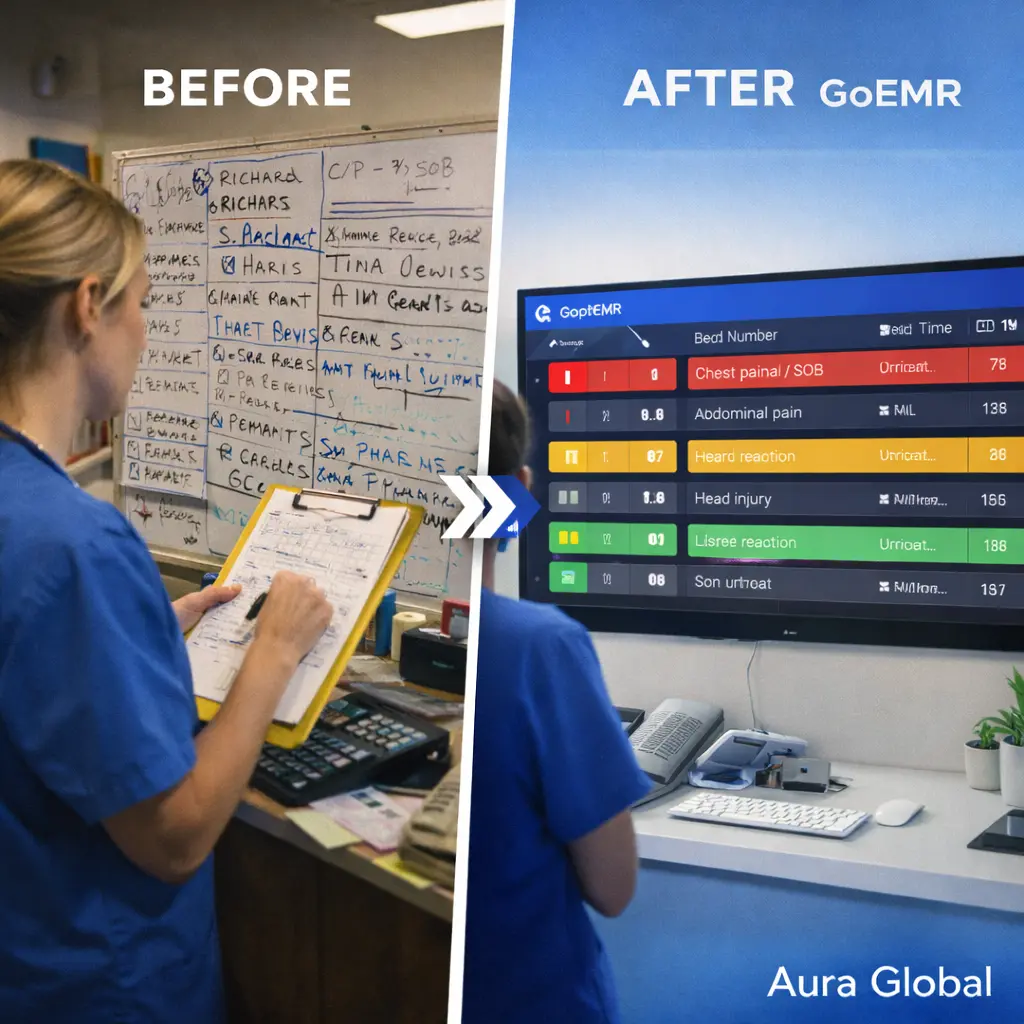
It's 2:17 AM. An ambulance radio crackles — two-vehicle collision, three incoming, one critical. The charge nurse turns to the whiteboard. Half the names are smudged. One bed number has been erased and rewritten so many times the marker won't stick. The triage nurse is on the phone trying to figure out which beds are actually open. A resident is looking for the chart on the chest pain in Bay 4, but nobody's sure if that patient was moved to Bay 7 or discharged an hour ago.
This is the reality of emergency departments running on whiteboards and memory. The information exists — scattered across clipboards, verbal handoffs, and the charge nurse's mental map. But when three traumas arrive simultaneously, scattered information isn't information at all. It's noise.
AuraEMR's Emergency Medicine module was built for exactly this environment — where seconds define outcomes, where clarity isn't a luxury but a clinical necessity, and where the system has to be faster than the chaos it's managing.
The Whiteboard Problem
Emergency departments have relied on physical whiteboards for decades. The concept is simple: write down every patient, their bed, their chief complaint, their provider, and their status. Erase and update as things change. It works — until it doesn't.
And in a busy ED, it doesn't work more often than anyone wants to admit:
- Legibility degrades — After twelve hours of erasing and rewriting, the board becomes a blur of half-visible names and smudged markers. Critical information becomes guesswork.
- Updates lag behind reality — A patient gets moved from Bay 3 to Bay 9, but the board still says Bay 3. The lab results are back, but nobody updated the status column. The whiteboard shows a version of the ED that existed twenty minutes ago.
- Single point of visibility — The board is on one wall. If you're not standing in front of it, you're working blind. Providers in treatment rooms, triage nurses at the front, and consultants calling from upstairs have no access to the current state of the department.
- No history, no audit trail — When a patient's status changes, the old information is erased. There's no record of when they arrived, when they were triaged, when they were seen, or how long they waited. Come morning, the board is wiped clean and the data is gone forever.
- Shift handoffs are verbal gambles — The outgoing charge nurse walks the incoming one through the board. Some details get passed on. Some don't. If the incoming nurse didn't catch that the patient in Bay 6 is a fall risk, that's a safety gap no one documented.
A whiteboard is a snapshot. An emergency department needs a live feed.
A Real-Time ED Board That Everyone Can See
AuraEMR replaces the physical whiteboard with a real-time digital ED board — a living dashboard that shows the current state of every patient, every bed, and every provider in the department. Not what the state was twenty minutes ago. Right now.
Here's what your team sees at a glance:
- Patient rows, color-coded by triage level — Red for critical (ESI 1), orange for emergent (ESI 2), yellow for urgent (ESI 3), green for less urgent (ESI 4), and blue for non-urgent (ESI 5). One look at the board tells you the acuity distribution of the entire department.
- Bed assignment and location — Every patient is mapped to a physical location. When a patient moves, the board updates. When a bed is cleaned and ready, the status flips automatically.
- Wait times and time-in-department — Real-time clocks show how long each patient has been waiting and how long they've been in the department. When a wait time crosses a threshold, it turns red — no one has to remember to flag it.
- Provider assignment — Every patient row shows the assigned physician, nurse, and any consulting specialists. Coverage gaps are visible immediately.
- Status tracking — Each patient has a current status: waiting, triaged, provider assigned, labs ordered, imaging ordered, results pending, disposition decided, admitted, discharged. The board is a workflow engine, not just a list.
- Accessible from anywhere — The board displays on wall-mounted screens in the department, but it's also accessible from any workstation, tablet, or mobile device on the network. The triage nurse at the front sees the same board as the attending in the trauma bay.
The result is total situational awareness. Nobody has to walk to the board, squint at handwriting, or ask the charge nurse where things stand. The department's status is visible to everyone, everywhere, all the time.
ESI Triage Scoring That Guides Decisions
Triage is the first clinical decision in every emergency visit — and it's one of the highest-stakes. An undertriage means a critical patient waits too long. An overtriage means resources are pulled from someone who needs them more. Getting it right, consistently, under pressure, with a waiting room full of people is one of the hardest jobs in medicine.
AuraEMR integrates the Emergency Severity Index (ESI) directly into the triage workflow:
- Structured triage documentation — Triage nurses follow a guided assessment that captures chief complaint, vital signs, pain level, and resource prediction. The system suggests an ESI level based on the inputs, but the nurse makes the final call.
- Decision support, not decision replacement — The system highlights clinical red flags: abnormal vitals, high-risk chief complaints (chest pain, stroke symptoms, pediatric fever), and patients whose presentation suggests they may be sicker than they appear. It's a safety net, not an override.
- Re-triage alerts — Patients waiting to be seen aren't static. A patient triaged as ESI 4 who's been waiting 90 minutes and whose heart rate is climbing may need re-evaluation. AuraEMR monitors for deterioration signals and flags patients whose condition may have changed since initial triage.
- Triage-to-bed time tracking — The clock starts when the patient is triaged. For high-acuity patients (ESI 1 and 2), the system tracks time-to-provider and flags delays automatically. No one has to manually monitor whether a critical patient has been seen.
Triage isn't just about sorting patients. It's about making sure the sickest patients get seen first, and that no one falls through the cracks while they're waiting. AuraEMR makes both of those guarantees measurable.
The triage nurse's instinct is irreplaceable. But instinct backed by structured data is safer for everyone.
EMTALA Compliance, Built In — Not Bolted On
The Emergency Medical Treatment and Labor Act (EMTALA) requires every hospital with an emergency department to provide a medical screening exam to anyone who presents, regardless of their ability to pay. It's a federal mandate with teeth — violations can result in fines up to $119,942 per incident, exclusion from Medicare, and civil lawsuits.
Despite the stakes, EMTALA compliance in many EDs is tracked with paper logs and good intentions. A patient who left without being seen might not get documented. A transfer that lacked proper physician certification might go unnoticed until an audit. AuraEMR changes that:
- Automatic MSE documentation — Every patient who presents to the ED triggers a medical screening exam requirement in the system. The MSE isn't complete until a qualified medical provider documents their findings. No shortcuts. No skipped steps.
- LWBS tracking — Patients who leave without being seen (LWBS) are flagged automatically with timestamps and documented attempts to provide care. This isn't just a metric — it's your legal record that you met your EMTALA obligation.
- Transfer certification — When a patient needs to be transferred to a higher level of care, AuraEMR enforces the EMTALA transfer checklist: physician certification that the benefits of transfer outweigh the risks, receiving facility acceptance, and appropriate transport arranged. The transfer doesn't proceed in the system until every requirement is met.
- Stabilization documentation — For emergency conditions, the system tracks stabilization efforts and ensures that patients aren't discharged or transferred before their emergency medical condition is stabilized — or before the proper exceptions are documented.
- Audit-ready reports — Every EMTALA-relevant action is timestamped, attributed to a specific provider, and stored permanently. When CMS comes knocking, your compliance history is a report, not a reconstruction.
EMTALA compliance isn't about checking boxes. It's about ensuring that every person who walks through your doors receives the care they're entitled to — and that your department can prove it.
Mass Casualty Incident Readiness
Nobody plans for a mass casualty incident on a Tuesday afternoon. But that's exactly when they happen — unannounced, overwhelming, and with no time to figure out your process on the fly. A multi-vehicle pileup. An industrial explosion. A building collapse. Suddenly your 30-bed ED needs to absorb 40 patients in 90 minutes.
AuraEMR includes built-in mass casualty incident (MCI) protocols that activate with a single command:
- MCI activation mode — One click switches the ED board into MCI mode. Triage shifts from the standard 5-level ESI to the START triage system (Simple Triage and Rapid Treatment) designed for high-volume scenarios: immediate, delayed, minor, and expectant.
- Rapid patient registration — In an MCI, you don't have time for full demographic intake. AuraEMR supports rapid registration with temporary IDs, physical descriptors, and triage tags that can be reconciled with full identities later.
- Resource tracking — The system tracks bed availability, ventilator counts, blood bank status, and OR capacity in real time. When you're making split-second decisions about who goes where, you need to know what resources are left — not what you started with.
- Family reunification support — In large-scale events, families are searching for loved ones. AuraEMR generates a patient locator feed (with appropriate privacy controls) that can be shared with hospital administration and social work teams.
- After-action reporting — Once the event is resolved, AuraEMR generates a comprehensive after-action report: patient volumes, triage distributions, time-to-treatment metrics, resource utilization, and outcomes. These reports are critical for hospital accreditation, quality improvement, and regulatory compliance.
You never want to use MCI mode. But when you need it, the difference between a system that's ready and a system that isn't is the difference between organized response and preventable harm.
The best time to prepare for a mass casualty event is before it happens. The second best time is right now.
Built for the Chaos
Emergency medicine is different from every other specialty. The patients are unscheduled. The conditions are unpredictable. The volume fluctuates wildly. The acuity can shift from routine to critical in the time it takes an ambulance to pull up. Any system designed for the ED has to account for all of this — not in theory, but in practice, at 3 AM, during a surge.
AuraEMR's Emergency Medicine module was designed with this reality at its core:
- Speed over ceremony — Every action in the ED module is optimized for speed. Placing an order takes two clicks. Documenting triage takes under a minute. Updating a patient's status is a single tap. In the ED, every second spent on the screen is a second not spent with the patient.
- Designed for interruption — ED providers don't sit at a workstation and chart for thirty minutes. They chart in fragments between patients, between interruptions, between codes. AuraEMR auto-saves continuously. Close the screen mid-note, and it's right where you left it when you come back.
- Shift-change resilience — When the night team hands off to the day team, the board is the handoff. Every patient's history, triage, orders, results, and pending actions are visible and current. No verbal-only handoffs. No "I think the patient in Bay 5 is waiting on CT."
- Surge capacity visibility — When the waiting room fills up and the beds are full, the system shows it. Real-time occupancy percentages, average wait times, and boarding patient counts give leadership the data they need to make diversion decisions, call in additional staff, or activate overflow protocols.
- Integration with the rest of the hospital — The ED doesn't exist in isolation. Lab orders flow to the lab. Imaging orders flow to radiology. Admission orders flow to the floor. Consult requests reach the on-call specialist. AuraEMR connects the ED to every department it depends on — in real time.
The ED is the front door of the hospital. It's where the sickest patients arrive first, where split-second decisions have permanent consequences, and where the margin for error is thinnest. The technology running it needs to be as fast, reliable, and unbreakable as the people who work there.
When the ambulance pulls up, your team should already be ahead. That's what AuraEMR is built for.
Built for the chaos. Designed for clarity.
AuraEMR's Emergency Medicine module gives your ED a real-time board, ESI triage scoring, EMTALA compliance tracking, and mass casualty protocols — everything your team needs when seconds define outcomes.