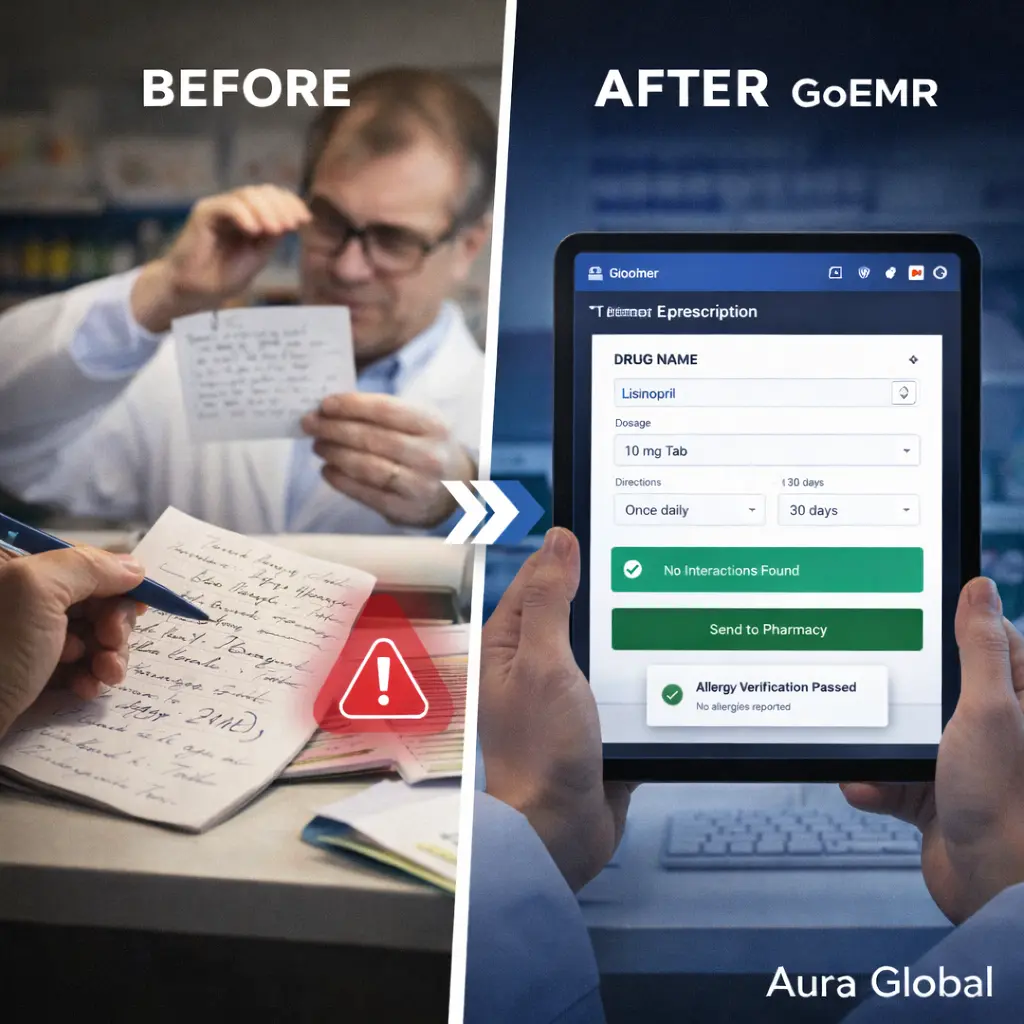
Handwritten prescriptions killed an estimated 7,000 people per year before e-prescribing became widespread. Let that sink in. Not 7,000 adverse reactions. Not 7,000 minor errors. Seven thousand deaths — from illegible handwriting, misread dosages, missed drug interactions, and prescriptions that should never have been written the way they were.
The pen-and-paper prescription pad was never a precision instrument. It was a liability dressed up as tradition. A scribbled "1.0 mg" that looked like "10 mg." A drug name abbreviated in a way that matched two different medications. An allergy noted in a chart that the prescribing physician never saw because it was buried on page three of a paper file. Every one of these failures was preventable. Every one of them had a human cost.
AuraEMR's E-Prescription module was built on a simple premise: the act of prescribing medication should never be the point where patient safety breaks down. One click from the encounter note to the pharmacy. Real-time safety checks at every step. No illegible orders. No guesswork. No excuses.
The Illegible Prescription Problem
For decades, the prescription process worked like this: a physician examined the patient, decided on a medication, pulled out a pad, and wrote a prescription by hand. The patient carried that slip of paper to a pharmacy, where a pharmacist attempted to decode what was written. If the pharmacist couldn't read it — and studies show that happened disturbingly often — they called the office, waited on hold, and hoped someone could decipher the original.
The failure points in this system were staggering:
- Illegible handwriting — The stereotype of doctor handwriting exists for a reason. Time-pressured physicians writing quickly produced prescriptions that were genuinely unreadable. A pharmacist misreading "Celebrex" as "Celexa" — an anti-inflammatory versus an antidepressant — isn't a hypothetical. It happened.
- Ambiguous abbreviations — "QD" (once daily) versus "QID" (four times daily). "U" for units that looks like a zero. "MSO4" that could be morphine sulfate or magnesium sulfate. The Institute for Safe Medication Practices maintains an entire list of abbreviations that should never be used — yet they appeared on handwritten prescriptions daily.
- Incomplete information — Paper prescriptions frequently lacked the patient's weight, allergies, or current medication list. The pharmacist filled what was written, without the clinical context needed to catch interactions or contraindications.
- No verification loop — Once the paper left the physician's hand, there was no automated check. No system flagged that the patient was already taking a medication that would interact dangerously with the new one. No alert warned that the dosage was ten times what a patient of that weight should receive.
- Lost prescriptions — Paper gets lost. Patients left the office, forgot the prescription in their car, or it fell out of a pocket. Then they called the office asking for it to be called in, creating more work and more opportunities for verbal miscommunication.
A prescription that can't be read correctly isn't a prescription. It's a hazard.
Real-Time Drug Interaction Checks
Drug interactions are one of the most common and most dangerous medication errors. A patient taking warfarin who gets prescribed a common NSAID without adjustment. A statin combined with a macrolide antibiotic that quintuples the risk of rhabdomyolysis. An SSRI prescribed alongside a triptan, creating serotonin syndrome risk. These aren't edge cases — they're everyday prescribing decisions that require awareness of every other medication the patient is taking.
No physician can memorize every drug interaction. There are thousands of medications on the market, and the interaction matrix is enormous. This is exactly the kind of task that technology should handle — and in AuraEMR, it does:
- Instant screening at the point of prescribing — The moment a provider selects a medication in AuraEMR, the system checks it against the patient's entire active medication list. If there's an interaction, the alert appears before the prescription is signed — not after it reaches the pharmacy.
- Severity-graded alerts — Not all interactions are equal. AuraEMR distinguishes between contraindicated combinations (never prescribe together), serious interactions (use with caution and monitoring), and moderate interactions (be aware). The alert tells you what the risk is, not just that one exists.
- Clinical context in every alert — An interaction alert that says "Interaction detected" and nothing else is useless. AuraEMR's alerts include the mechanism of the interaction, the potential clinical consequence, and suggested alternatives when available. The provider gets the information they need to make a decision, not just a red flag.
- Override with documentation — Sometimes the right clinical decision is to prescribe despite an interaction — with appropriate monitoring. AuraEMR allows overrides but requires the provider to document their reasoning. This creates a safety record that protects both the patient and the provider.
- Database updates — New drug interactions are identified regularly as post-market surveillance data accumulates. AuraEMR's interaction database is continuously updated to reflect current evidence, not a static list from five years ago.
The goal isn't to slow down prescribing. It's to make prescribing safer without adding friction. The check takes milliseconds. Reading the alert takes seconds. And catching a dangerous interaction before it reaches the patient? That's priceless.
Allergy Cross-Referencing That Actually Protects
Allergy documentation in paper-based systems is notoriously unreliable. Allergies get written on intake forms and never transferred to the chart. A patient reports a penicillin allergy to the nurse, but the physician doesn't see the note. A known sulfa allergy sits in one part of the record while a sulfa-containing medication is prescribed from another. The information exists — it just isn't connected to the prescribing workflow.
AuraEMR eliminates this gap entirely by making allergy checking a mandatory, automated step in every prescription:
- Allergy list integrated into prescribing — The patient's documented allergies are visible at all times during the prescribing workflow. They're not hidden in a separate tab or buried in the chart. When you're selecting a medication, the allergies are right there.
- Cross-class allergy detection — A patient allergic to penicillin may also react to certain cephalosporins. AuraEMR checks not just for exact matches but for cross-reactivity between drug classes. The system knows that an amoxicillin allergy means caution with cephalexin, even if the patient only reported "penicillin."
- Severity and reaction type — There's a clinical difference between "penicillin gives me a rash" and "penicillin caused anaphylaxis." AuraEMR's allergy records include the type of reaction and its severity, so providers can make informed risk-benefit decisions rather than treating all allergies as absolute contraindications.
- Inactive ingredient screening — Some allergies aren't to the active drug but to an inactive ingredient — a dye, a filler, a preservative. AuraEMR's allergy cross-referencing extends to known inactive ingredients in common formulations, catching reactions that a simple drug-name match would miss.
- Patient-reported vs. confirmed allergies — AuraEMR distinguishes between patient-reported allergies and clinically confirmed ones. Both trigger alerts, but the distinction helps providers make better decisions about whether a "reported allergy" warrants avoidance or further evaluation.
An allergy documented but not checked is the same as an allergy not documented at all.
Controlled Substance E-Prescribing (EPCS)
Controlled substance prescribing carries additional regulatory requirements, additional abuse risks, and additional consequences when errors occur. For years, these prescriptions required paper with special security features — tamper-resistant pads, manual signatures, and physical delivery to the pharmacy. This created a parallel prescribing workflow that was slower, less secure, and harder to track than e-prescribing for non-controlled substances.
AuraEMR supports Electronic Prescribing of Controlled Substances (EPCS) in full compliance with DEA regulations:
- Two-factor authentication — Every controlled substance prescription requires two-factor authentication from the prescribing provider. Something you know (password) plus something you have (a hardware token or biometric). This meets the DEA's identity proofing requirements and prevents unauthorized prescribing.
- Audit trail for every prescription — Every controlled substance prescription is logged with the prescriber's identity, the time of prescribing, the patient, the drug, and the quantity. These records are immutable and available for audit at any time. No lost prescription pads. No forged signatures.
- PDMP integration — AuraEMR integrates with state Prescription Drug Monitoring Programs (PDMPs) to show a patient's controlled substance fill history at the point of prescribing. Before writing a new opioid prescription, the provider can see what the patient has already received, from whom, and when — across all pharmacies in the state.
- Quantity and refill controls — Schedule II medications cannot have refills — the system enforces this automatically. Schedule III through V refill limits are tracked and enforced. Quantity limits based on state regulations are built in. The system doesn't allow prescriptions that violate the rules, even if the provider makes a mistake.
- Elimination of paper diversion risks — Paper prescriptions for controlled substances can be stolen, altered, or forged. EPCS eliminates this attack vector entirely. The prescription travels digitally from the provider to the pharmacy, encrypted and authenticated at both ends.
EPCS isn't just a convenience — it's a security measure. It protects patients from diversion, protects providers from fraud, and protects the practice from regulatory exposure. Every controlled substance prescription should flow through a system this secure.
Refill Tracking and Renewal Alerts
Medication adherence is one of healthcare's most stubborn challenges. Patients don't fill their prescriptions. They fill them once and don't refill. They run out and forget to request a renewal. They switch pharmacies and the history gets lost. And in the middle of all this, the provider has no visibility into whether the patient is actually taking the medication that was prescribed.
AuraEMR's refill tracking brings this invisible process into the light:
- Automatic refill monitoring — When a prescription is sent with refills authorized, AuraEMR tracks whether those refills are being used. If a patient was prescribed a 30-day supply with two refills and hasn't filled the second refill by day 65, the system flags it. This isn't just a billing concern — it's a clinical one. A patient not refilling their blood pressure medication is a patient at risk.
- Renewal alerts before patients run out — For chronic medications, AuraEMR calculates when the patient's current supply will run out based on the dosage and quantity dispensed. Providers receive renewal alerts in advance, not after the patient calls in a panic because they've been without their statin for a week.
- Pharmacy fill confirmation — AuraEMR receives fill confirmations from connected pharmacies, so providers can see not just what was prescribed but what was actually dispensed. A prescription that was sent but never filled is a red flag that deserves follow-up.
- Prior authorization tracking — When a pharmacy rejects a prescription because it requires prior authorization, AuraEMR captures that rejection and alerts the care team. The PA process can begin immediately, instead of waiting for the patient to call and report that the pharmacy wouldn't fill it.
- Medication reconciliation support — At every visit, AuraEMR presents the patient's current medication list with fill status, making medication reconciliation faster and more accurate. Providers can quickly identify medications that have been prescribed but not filled, filled but possibly not taken, or filled at a frequency that suggests overuse.
A prescription that isn't filled is a treatment that never happened. Visibility into refills isn't administrative overhead — it's clinical intelligence.
One Click from Encounter Note to Pharmacy
The entire point of e-prescribing is to remove friction from the prescribing process while adding safety. AuraEMR delivers on both of those promises by making the path from clinical decision to pharmacy delivery as short and secure as possible.
Here's what the prescribing workflow looks like in practice:
- Prescribe from within the encounter — Providers don't switch to a separate prescribing application. The prescription is created directly from the encounter note, with the patient's diagnoses, allergies, and medication list already loaded. Context travels with the prescription.
- Smart drug search with auto-complete — Start typing a drug name and AuraEMR auto-completes with matching medications, showing available strengths, formulations, and generic alternatives. No memorizing NDC codes. No flipping through formulary books.
- Formulary verification — Before the prescription is signed, AuraEMR checks the patient's insurance formulary to verify coverage. If the selected medication isn't covered, the system suggests formulary alternatives, saving the patient a rejected claim and the provider a callback from the pharmacy.
- Pharmacy selection and transmission — The patient's preferred pharmacy is stored in their profile. One click sends the prescription electronically through the Surescripts network — the same infrastructure used by the vast majority of pharmacies in the country. No faxing. No phone calls. No paper.
- Confirmation and documentation — Once the pharmacy receives the prescription, AuraEMR logs the confirmation. The prescription appears in the patient's medication list, in the encounter note, and in the longitudinal record. The entire transaction is documented, timestamped, and auditable.
The result is a prescribing process that's faster than writing on a pad, safer than any paper-based system, and fully documented from the moment the provider selects a medication to the moment the patient picks it up at the pharmacy.
Patient safety isn't optional. It never was. The difference is that now there's a system built to enforce it at the point where it matters most — the moment a medication is prescribed.
Safe. Fast. Compliant. One click to the pharmacy.
AuraEMR's E-Prescription module eliminates illegible orders with real-time drug interaction checks, allergy cross-referencing, formulary verification, and EPCS support — because patient safety isn't optional.